A developer once pitched me on rebuilding a client’s site headless, and his opening line was “it’ll be way faster.” I asked how much faster, in real numbers, for a five-page service business site that was already scoring well on PageSpeed. He didn’t have an answer. He had a framework preference. Those are two very different things, and mixing them up is how businesses end up spending five figures on an architecture change that solves a problem they didn’t actually have.
Headless WordPress has been the trendy answer to “how do we make our site better” for a few years now, and in 2026 it’s more mature and more talked about than ever. It’s also, for the vast majority of small businesses, the wrong answer. Not because it’s bad technology. Because it’s a specific tool for a specific problem, and most sites don’t have that problem.
What “Headless” Actually Means, in Plain Terms
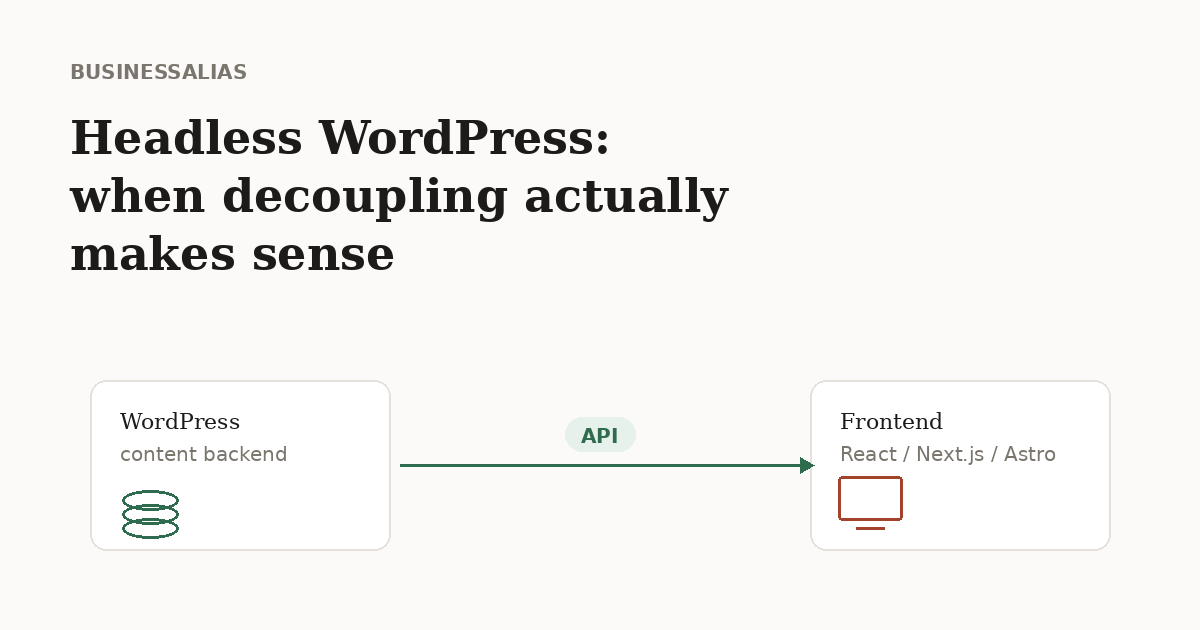
Regular WordPress does two jobs at once. It stores your content, and it also builds the actual page your visitor sees, using PHP and your theme. One system, two responsibilities, tightly connected.
Headless WordPress splits those jobs apart. WordPress keeps managing your content, your posts, your pages, your media library, the parts your team already knows how to use. But instead of WordPress also generating the visible page, that job gets handed to a separate frontend, usually built with a JavaScript framework like Next.js or Astro, which pulls the content through an API and renders it however the developers want.
Think of it as firing your in-house chef but keeping the pantry. The pantry still holds all your ingredients, organized the same way it always was. You just hired an outside kitchen to actually cook and plate the meal.
The Case For It, When It’s Real
The performance argument isn’t fake. Decoupled frontends built with modern frameworks can genuinely outperform even a well-optimized traditional WordPress site, especially for interaction-heavy, app-like experiences. One agency case study reported a SaaS client’s bounce rate dropping 60% after a headless relaunch, and that kind of number is realistic when the original site was fighting against page-builder bloat rather than a lean, purpose-built frontend.
The stronger case, though, isn’t speed. It’s distribution. If your content genuinely needs to feed a website, a mobile app, and maybe a kiosk or partner platform simultaneously, headless earns its complexity, because you’re managing one content source instead of duplicating it across three separate systems. Multi-channel content delivery is where decoupled architecture stops being a preference and starts being the only sane option.
It also makes sense when your team is fundamentally JavaScript-first. If your developers live in React and fighting with PHP templates slows them down more than learning an API integration would, headless removes friction rather than adding it.
The Case Against It, Which Is Most of the Time
Here’s the blunt version most agencies won’t say out loud, because headless builds cost more to sell: for most small business websites, service sites, blogs, and standard ecommerce stores, traditional WordPress remains the more practical choice, full stop.
The cost gap is real and often underestimated. Headless requires paying for specialized development to build the API structure, the frontend components, and the deployment pipeline, on top of the WordPress backend you’re already running. Traditional WordPress, by contrast, lets you launch with pre-built themes and visual builders, keeping both time-to-launch and ongoing costs dramatically lower.
The maintenance burden shifts too, and not in a good way for non-technical teams. Plugin-based functionality, drag-and-drop page building, SEO tools, contact forms, most of the 59,000-plus plugins the WordPress ecosystem is famous for, don’t work directly in a headless setup. Anything that outputs a shortcode or HTML through a plugin typically needs to be custom-rebuilt on the frontend. That “just install a plugin” fix your marketing team relies on stops being an option, and now needs a developer instead.
The SEO Trap Nobody Mentions Upfront
This one catches people off guard. Headless can absolutely perform well for search, but it takes deliberate engineering to get there, not default behavior. Metadata handling, sitemap generation, and structured data all typically live outside WordPress themes in a headless setup and have to be explicitly built and maintained on the frontend.
There’s a newer wrinkle worth knowing about too: content freshness signals, the “last updated” timestamps that AI search tools increasingly weight when deciding what to cite, are handled automatically by traditional WordPress themes but have to be manually passed through and rendered by a headless frontend. Skip that step, and you’re invisible to a growing category of AI-driven discovery even if your content is genuinely current.
None of this makes headless bad for SEO. It makes it a project with an extra checklist that traditional WordPress simply doesn’t require.
The Middle Ground Most People Actually Want
If full headless sounds like too much and traditional sounds limiting, there’s a real answer between them: hybrid headless, where WordPress stays as the content backend but a lighter, purpose-built frontend handles just the parts where speed genuinely matters, while the rest of the site stays conventional. It’s not all-or-nothing anymore, and for a business that wants specific pages to feel instant without rebuilding the entire site, that’s often the more honest starting point than jumping straight to full decoupling.
The Actual Decision Framework
Skip the “is headless better” debate entirely and ask these instead:
Do you need to deliver content to more than one platform at once? Website, app, kiosk, partner feed. If yes, headless earns its keep.
Is your marketing team non-technical and dependent on visual editing? If content editors need to build and launch landing pages themselves without a developer, traditional WordPress protects that independence. Headless takes it away unless you invest heavily in a custom live-preview system.
Is your current site actually slow, measured, not assumed, after real caching and CDN setup? A well-configured traditional WordPress site can hit strong Core Web Vitals scores at a fraction of headless’s cost. Fix the caching and plugin bloat first before blaming the architecture.
Do you have, or can you afford, dedicated development resources for the frontend, ongoing, not just at launch? Headless isn’t a one-time cost. It’s a permanent shift in who maintains your site.
If your honest answers point toward “no” on most of these, you’re not missing out by staying traditional. You’re making the decision the data actually supports.